
Natalie Paull’s Featherlight Sponge Cake Recipe
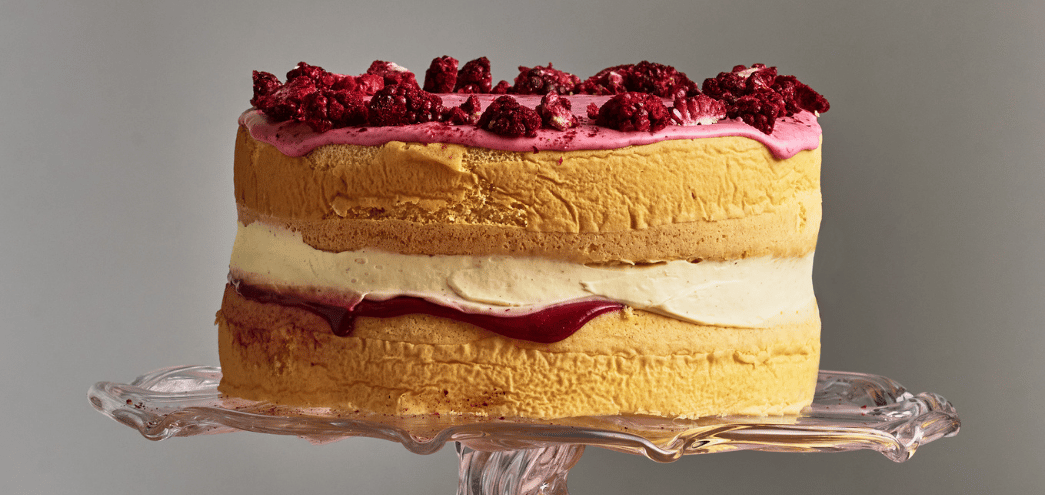
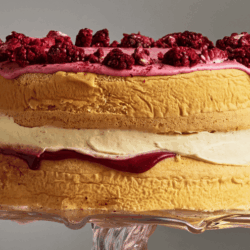
Beatrix Bakes’ cult-favourite sponge, glazed in blackberry and lime, layered in cloud-soft cream. This is the showstopper your high tea table has been waiting for.

The Melbourne baker behind Beatrix Bakes has spent years perfecting this recipe and the result is the sponge that had queues forming on Queensberry Street.
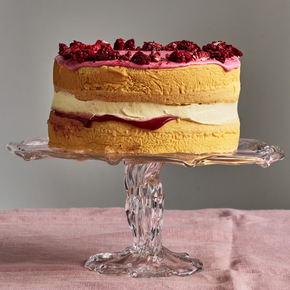
Two impossibly light layers, built on a firm meringue base and finished with hot milk and butter for extra lift, sandwich a filling of billowy cream and a blackberry and lime curd sharp enough to cut through the sweetness. The whole thing is crowned with a sour cream glaze, its faint tang balancing the icing sugar, and finished with a scattering of freeze-dried fruit.
Paull’s method is generous with its tricks, guiding you through every fold and temperature cue along the way. Set aside an afternoon, let the sponge chill overnight, and you’ll be rewarded with a cake that slices clean and tastes even better than it looks.
Serve it as the centrepiece of a high tea at home, alongside good tea and better company.
Images and text from Sweet Heart by Natalie Paull, photography by Rochelle Eagle. Murdoch Books RRP $49.99

Ingredients
Sponge Layers
- cooking oil spray
- 210 g (7½ oz) egg whites, plus 120 g (4¼ oz) egg yolks, from approx. 6–7 eggs
- ¼ teaspoon (2 g) cream of tartar
- 170 g (6 oz) caster (superfine) sugar
- 70 g (2½ oz) soft plain (all-purpose) flour (8–9% protein), plus extra regular plain (all-purpose) flour (10% protein) to dust the tins
- 70 g (2½ oz) wheaten cornflour (cornstarch)
- 20 g (¾ oz) custard powder or extra cornflour (cornstarch)
- ½ teaspoon (3 g) baking powder
- ⅛ teaspoon (1 g) fine sea salt
- 15 g (½ oz) unsalted butter,
- 50 g/ml (1¾ oz) full-fat (whole) milk
- 1 teaspoon (5 g) vanilla bean paste
Filling
- 360 g/ml (12¾ oz) whipping (heavy) cream (35% fat)
- 1 teaspoon (5 g) vanilla bean paste
- ½ batch Blackberry & lime curd (see below)
Sour Cream Glaze
- 50 g (1¾ oz) frozen blackberries
- 200 g (7 oz) icing (confectioners’) sugar mixture
- 60 g (2¼ oz) full-fat sour cream, plus extra as needed
To Finish
- freeze-dried fruits (optional)
Method
- Prepare your equipment Preheat the oven to 170°C (350°F) fan-forced. Tin prep is everything for this sponge. Lightly spray two 20 cm (8 inch) round, 5 cm (2 inch) deep cake tins with cooking oil spray and line the bases only with a snug circle of baking paper. Spray the paper base lightly again. Sprinkle the insides of the tins with a little extra flour and tap out the excess. This helps the batter grip the sides as it rises. Spray only the bases one last time and very, very lightly.
- Make the sponge batter Put the egg whites and cream of tartar in the bowl of an electric stand mixer with the whisk attachment (or use hand-beaters). Whip on just below high speed for 3–4 minutes until the whites change from foamy to a stiff and creamy white. Once glossy, gradually add the sugar, a tablespoon at a time, over 3 minutes, to make a shiny and very stiff meringue. While the whites whip, sift the flours, custard powder, baking powder and salt five times and leave the sieve on top for later (see Top Trix 1).
Place the butter, milk and vanilla in a bowl or pan ready to heat (microwave or stovetop). When it comes time to add these to the batter, they should be very warm.
As soon as all the sugar has been incorporated, tap the meringue off the whisk into a wide bowl. Scrape in the rest of the meringue. Fold the yolks in until the mix is marbled apricot coloured. Sift half the flour mix over the foam, then fold with gentle intent with a balloon whisk until it is almost incorporated. Heat the butter/milk now while you sift over the remaining flour, folding until completely incorporated and beginning to stiffen. (See Top Trix 2.)
Working very quickly now, pour the warm butter, milk and vanilla mix gently around the edge of the bowl and fold in with the balloon whisk, using gentle but decisive folding strokes until the batter is well mixed but still fluffy. - Bake! Divide the fluffy batter between the prepared tins – approx. 300 g/ml (10½ oz) each – and quickly smooth the tops. Bake for 16–18 minutes until the sponge tops are a light golden colour and springy to the touch. Remove the cakes from the oven and lightly spray the tops of the cake with cooking oil. Flip them gently out onto the rack and remove the tin, then carefully peel back the paper. (If they steam in the tin, they will toughen.) Leave to cool completely for 40 minutes. Do not flip top-side up until cool.
When cool, flip the sponge cakes top-side up and don’t worry if some of the top crust comes off. Shave the tops off both the sponges with a sharp serrated knife. - Make the filling Whip the cream and vanilla until billowy soft but starting to hold its form.
- Fill the sponge Smooth the blackberry curd over the cut side of the base cake. Pile the cream on top and place the second layer trimmed-side down to sandwich. Push down gently to coax the cream to slightly squish out the sides. Swipe around the sides to neaten up the cream. Wrap a collar of plastic wrap around the sides of the cake and then a piece on top lightly. Chill for a minimum of 3 hours or overnight. (See Top Trix 3.)
- Glaze the cake Zap the frozen blackberries until most of the juice has evaporated. Add to a wide bowl along with the icing sugar and sour cream. Hand-whisk hard – it will take a moment to get a paste happening. From here, add teaspoons of sour cream as needed until the glaze is a thick paste with a ‘lazy ooze’ consistency after moving your whisk through. It must be spreadable yet not runny. If it is super runny, add more icing sugar – it will be sweeter but at least it will set.
Unwrap the cake. Pour almost all the glaze (hold back approx. 1 tablespoon) into the centre and push towards the edges, taking care not to tear any of the crust as you smooth. Sprinkle on the crushed freeze-dried fruits, if desired. - Keep and store Refrigerate for up to 2 days. Wrap a collar of plastic wrap around the circumference of the cake. Press plastic wrap up to any cut sides if you have taken a slice. Can be frozen for up to 3 months, but the cream can behave badly and weep (the liquid separates) when thawed.
Top Trix
- Myth-busting Sifting isn’t to add air to a batter. Sifting is blending. Flour and cornflour (cornstarch) and custard powder don’t mix well unless sifted together multiple times. If you skip this mixing, the flours incorporate into the batter at different rates and you get a lumpy batter.
- Fold well before adding the milk/butter. You want to start feeling a taut resistance when folding and see the volume start to drop a smidge. These are your two cues to add the milk. If you add before that, the egg is not fully protected by its flour jacket and will deflate.
- During this chill period, the sponge draws in the cream’s moisture, both firming the cream (so it doesn’t squish out when you cut) and moistening the sponge. The layers fuse, so your sponge layers have structural togetherness.
Blackberry & lime curd recipe
MAKES approx. 220 g (7¾ oz) curd T
TAKES 30 minutes to mix and cook and minimum 1 hour to chill
Ingredients
- 125 g (4½ oz) fresh blackberries
- 1 large lime (choose one that yields when squeezed, to confirm juiciness)
- 80 g (2¾ oz) caster (superfine) sugar
- 60 g (2¼ oz) unsalted butter, squidgy soft (22°C/72°F)
- 60 g (2¼ oz) egg yolks, from approx. 3 eggs
- ¼ teaspoon (2 g) citric acid
Method
- Set up a double boiler over a low heat to simmer.
- Whiz the blackberries in a food processor, then strain, pushing the pulp vigorously through a fine non-reactive sieve into a bowl. Weigh the purée – you need 110 g/ml (3½ oz). If underweight, top up with extra puréed blackberries or lime juice. Discard the seeds.
- Add the lime Zest and juice the lime. Add all the zest and 20 g/ml (¾ oz) of the juice to the blackberry purée.
Add the remaining ingredients to the blackberry/lime juice and hand-whisk well until just combined. - Cook the curd Place the bowl over the double boiler. Hand-whisk often but not constantly. Scrape the side of the bowl down each time you whisk – the mix at the side will cook faster, so you want to incorporate that regularly. Cook and temp check the curd to 82°C (180°F) – always whisk the mix before testing. The curd will look thick and gloopy and your whisk will leave raised marks in the mix when lifted out.
- Chill Remove the bowl from the double boiler and leave aside to cool, whisking occasionally while it cools so a thick skin doesn’t form on top. Scrape the curd into a jar or tub, press a small piece of plastic wrap on the surface (preventing a skin forming) and chill for 2–3 hours (minimum 1 hour). Pop the lid on when it has fully chilled so no sweat forms. (Sweat development accelerates the formation of mould.)
- Keep and store Refrigerate for up to 7 days, or freeze for up to 3 months – thaw in the fridge.
ADAPTRIX
Can I use frozen blackberries?
Yes, but thawed frozen fruit can yield less juice so start with extra fruit – approx. 180 g (6¼ oz). Thaw at room temp or express-thaw in the microwave. Whiz and strain the juice as per step 2.
Frozen raspberries
Conversely, frozen rasps yield more juice than their fresh friends. Use 150 g (5½ oz) frozen raspberries (thaw at room temp or in the microwave). The curd will turn a subtle crimson.
Discover More Recipes